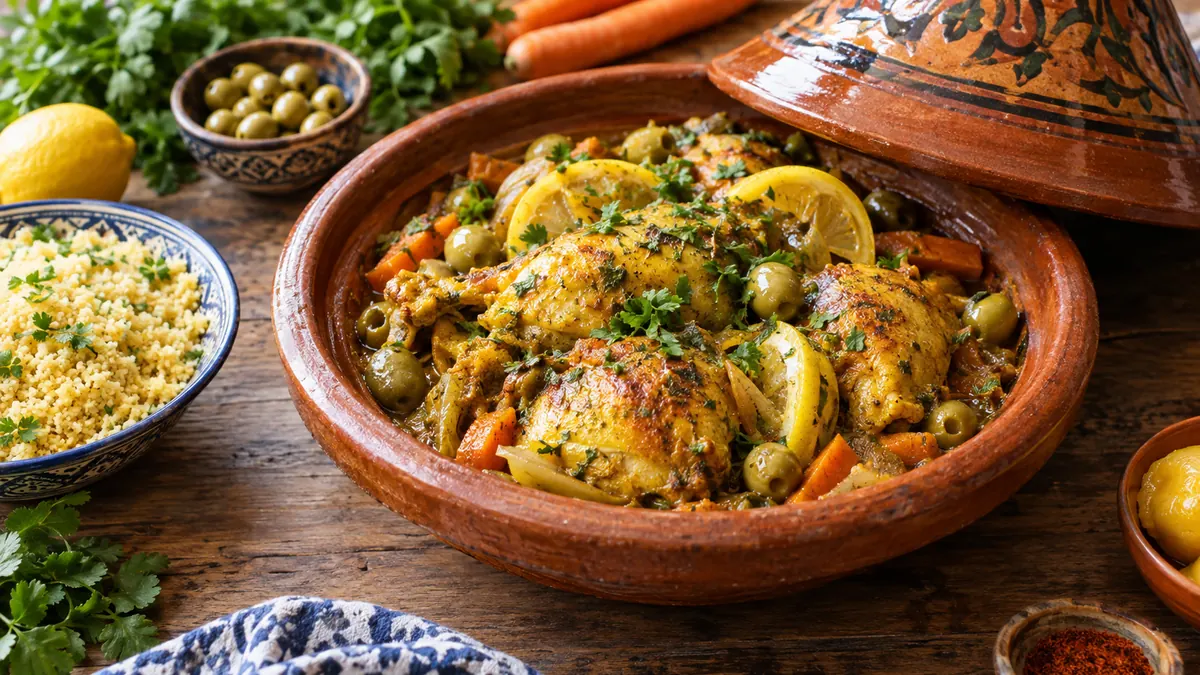
Why Is the Tagine Pot Shaped Like That? The Story and a Moroccan Chicken Recipe
The word tagine means two things: the conical clay pot used in North African cooking, and the slow-cooked stew made inside it. Tagines are a staple in Morocco, Tunisia and Algeria, and they show how North African cooks combine sweet, savory and warm spices. This recipe uses halal chicken, olives and preserved lemon, with no alcohol or pork.
The story of the tagine
Food writers describe the tagine as believed to be of nomadic Berber origin. The pot worked like a portable oven that let people cook while on the move. A shallow base held the food, and a tall cone-shaped lid trapped steam. The pot could be set over a small charcoal fire, which made it practical in places where fuel and water were limited.
The shape does clever work. As the stew simmers, steam rises into the cone, cools against the sides, and drips back down. This keeps the meat moist and allows it to cook with very little added liquid. Over time, the tagine became part of daily life in Morocco and neighboring countries, and the dishes cooked in it grew to reflect the region’s trade and history, with spices, dried fruit and preserved foods.
Do you need a tagine pot?
No. A heavy casserole with a tight lid works well. A tagine pot is lovely to cook and serve in, and it gives a gentle, even heat, but you will get good results with a Dutch oven. If you buy a clay tagine, check whether it is meant for cooking or just for serving, and season it before first use according to the maker’s instructions.
Ingredients (serves 4 to 6)
- 1.2 kg halal chicken thighs and drumsticks, skin on or off
- 2 tbsp olive oil
- 2 onions, finely sliced
- 4 cloves garlic, minced
- 1 tsp ground ginger
- 1 tsp ground cumin
- 1 tsp paprika
- 1 tsp turmeric
- 1/2 tsp ground cinnamon
- Pinch of saffron threads (optional)
- 1 1/2 cups (360 ml) chicken stock or water
- 1 preserved lemon, rind only, sliced
- 1 cup green or purple olives
- 1/4 cup chopped fresh coriander and parsley
- Salt and pepper
Method
- Mix the chicken with half the spices, a little salt and 1 tbsp of the oil. Marinate for at least 30 minutes, or overnight in the fridge.
- Heat the remaining oil in the base of the tagine or a heavy pot over medium heat. Brown the chicken for 3 to 4 minutes on each side. Remove and set aside.
- In the same pot, cook the onions for 8 minutes until soft and golden. Add the garlic and the remaining spices and cook for 1 minute.
- Return the chicken, add the stock, and bring to a gentle simmer.
- Cover and cook on low heat for 45 minutes, until the chicken is tender and the sauce is reduced.
- Add the preserved lemon and olives and cook for 10 minutes more.
- Scatter with fresh herbs and serve with couscous or bread.
Tips
Keep the heat low. A tagine cooks gently, and a hard boil will dry the meat. Do not lift the lid too often, since you will lose steam. Rinse preserved lemon briefly before using to control saltiness, and use only the rind. If your sauce is thin at the end, uncover and simmer for 5 to 10 minutes.
Variations
Make lamb tagine with prunes and almonds, a classic sweet and savory pairing. Make a vegetable tagine with chickpeas, carrots, potatoes and zucchini. Cook a kefta tagine with halal meatballs and eggs. Add apricots or dates to chicken for a sweeter flavor.
Halal notes
Choose halal meat. Be sure that any stock cubes or spice blends contain no alcohol or non-halal additives. Preserved lemon is made with salt and lemon, and olives are plant-based.
Storage
Tagines taste better the next day. Store in the fridge for up to three days, and reheat gently with a splash of water. The stew freezes well for up to two months, without the olives.
Frequently asked questions
What do I serve with a tagine? Couscous, flatbread, or plain rice. A simple salad of tomato and cucumber is good too.
Can I use chicken breast? Yes, but it dries out easily. Add it for the last 20 minutes only.
How do I make preserved lemon? Cut lemons into quarters, pack them with salt in a jar, press down, add lemon juice to cover, and leave them for four weeks. You can also buy them.
Is the dish spicy? Moroccan tagines are fragrant rather than hot. Add harissa on the side if you want heat.
Sources
The nomadic Berber origin and the design of the cooking vessel are described by Britannica (https://kids.britannica.com/scholars/article/tagine/638399) and Food Network (https://www.foodnetwork.com/how-to/packages/shopping/articles/what-is-a-tagine).
Building the flavors of Moroccan cooking
Moroccan cooks think in layers. First comes the base of onion, garlic and oil. Then come warm spices, such as ginger, cumin, paprika and turmeric. Finally, bright or sweet touches finish the dish: preserved lemon, olives, fruit, honey or fresh herbs. If you remember that order, you can create your own tagines with ingredients you have. A spoon of honey with prunes and cinnamon turns lamb into a festive dish, and a squeeze of lemon with olives lifts chicken.
Serving and presenting
Bring the tagine to the table in the pot, with the lid on, and lift it in front of guests so the aroma comes out. Serve with warm bread to scoop the sauce, since in Moroccan homes the bread is often used as a spoon. A bowl of couscous steamed with a little butter and a plate of fresh salad finish the meal. Mint tea is the traditional drink to end it.
Cooking in a regular pot
If you use a Dutch oven, cook at a low simmer on the stove, or in the oven at 160 C (320 F) for 1 hour. The result is just as tender. Add a little extra liquid if your lid does not fit tightly.