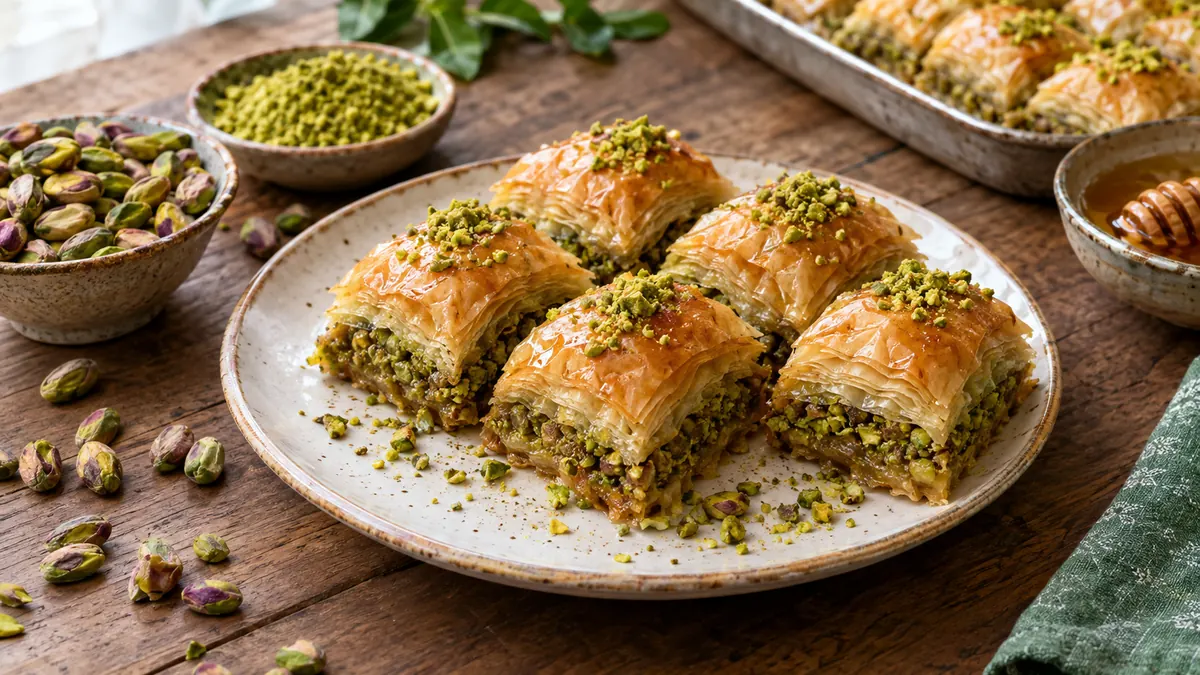
The Sweet History of Baklava, and a Simple Pistachio Recipe to Try Tonight
Baklava is a dessert of thin, buttery pastry layers, chopped nuts and sweet syrup. It is served at weddings, on Eid, and in bakeries across the Middle East, the Balkans and beyond. Making it at home takes time, but the steps are simple, and the result is worth the effort. It is also easy to keep halal, since it contains no gelatin and no alcohol.
A dessert with many beginnings
Few foods have as many stories as baklava. Some historians point to the Assyrians in the eighth century before the common era, who are said to have layered flatbread with chopped nuts for special occasions. Others point to ancient Greek and Roman layered pastries. Some say Persian cooks developed a version, and many link the baklava we know today to the Ottoman palace kitchens, where cooks stretched dough into paper-thin sheets.
The earliest record of baklava in its modern form is placed in Damascus by some sources, from which it spread to cities such as Gaziantep in Turkey, which is famous for its pistachio baklava. Turkey, Greece, Lebanon, Syria and others all claim it. There is no agreed answer, and the sensible view is that it grew from many kitchens and many centuries.
Ingredients (makes about 24 pieces)
For the pastry: - 1 package (about 450 g) phyllo dough, thawed in the fridge overnight - 1 cup (225 g) unsalted butter, melted - 3 cups (400 g) pistachios, walnuts or a mix, finely chopped - 1 tsp ground cinnamon - 1/2 tsp ground cardamom
For the syrup: - 1 1/2 cups (300 g) sugar - 1 cup (240 ml) water - 1 tbsp lemon juice - 1 tbsp rose water or orange blossom water (check it has no alcohol, if you avoid it)
Method
- Heat the oven to 175 C (350 F). Brush a 23 x 33 cm baking dish with butter.
- Mix the chopped nuts with the cinnamon and cardamom.
- Lay one sheet of phyllo in the dish and brush with butter. Repeat until you have 8 sheets. Keep the remaining dough covered with a damp towel so it does not dry out.
- Spread half the nut mixture over the pastry. Add 4 more sheets, brushing each with butter, then the rest of the nuts.
- Finish with 8 to 10 buttered sheets. Brush the top generously with butter.
- Cut into diamonds or squares before baking, all the way through. This is important, because the baked pastry will shatter if you cut it afterward.
- Bake for 45 to 50 minutes, until deep golden.
- While it bakes, simmer the sugar, water and lemon juice for 10 minutes. Stir in the flower water and let the syrup cool.
- Pour the cooled syrup over the hot baklava as soon as it comes out of the oven. You should hear a sizzle. Rest for several hours before serving.
Why cold syrup on hot pastry
The contrast matters. Hot pastry and cold syrup keeps the layers crisp. If you pour hot syrup on hot baklava, the pastry turns soggy. If you pour cold syrup on cold pastry, it will not absorb evenly. Pour the syrup slowly and evenly over the cuts.
Tips
Work quickly and keep the phyllo covered. Use clarified butter if you want an even crisper result. Chop the nuts by hand or pulse briefly, since a fine powder makes the filling dense. Use a very sharp knife to cut the layers. If the sheets tear, do not worry, since buttered layers hide small flaws.
Variations
Use pistachios for a bright green filling in the Gaziantep style. Use walnuts for a Greek style, flavored with cinnamon and cloves. Replace some of the sugar syrup with honey for a different flavor. Make a vegan version with olive oil or plant butter.
Halal notes
Baklava is usually halal. Read the labels of the phyllo, as some brands use animal fats. Check that flavor waters and vanilla are alcohol-free. Use butter or oil, not lard.
Storage
Keep baklava uncovered or loosely covered at room temperature for up to a week. Avoid the fridge, which hardens the butter and softens the pastry. You can freeze it for up to two months.
Frequently asked questions
Why is my baklava soggy? The syrup was too hot, too much was used, or the baklava was stored in a sealed container while still warm.
Can I use puff pastry? It is not the same, but it can work as a shortcut. The texture will be flakier and less delicate.
How sweet should it be? Traditionally quite sweet. Use less syrup if you prefer a lighter dessert.
What is the best nut? Pistachio is often considered the most prized. Walnut is more common and cheaper.
Sources
Historical accounts of baklava’s possible origins come from Smithsonian Magazine (https://www.smithsonianmag.com/travel/the-sticky-history-of-baklava-180982771/) and Turkish Culture Foundation (http://www.turkishculture.org/culinary-arts/desserts-sweets/baklava-310.htm). Several regions claim the dish, so the history is presented as contested.
Serving and gifting
Baklava is often served with strong tea or Arabic coffee, which balances the sweetness. Cut a few pieces smaller if you serve guests who prefer a light taste after a heavy meal. It is a popular gift at Eid and other holidays. Place the pieces in paper cups in a tin, and keep layers separated by baking paper so they do not stick. For a special platter, sprinkle crushed pistachios on top just before serving, because the nuts stay bright and crunchy when added at the last moment.
Making it ahead
Baklava is one of the best desserts to make a day ahead. The syrup needs time to soak through, and the flavor deepens overnight. Bake it the evening before, let it cool fully, and leave it uncovered at room temperature until morning. If your kitchen is humid, cover it loosely with a clean cloth instead of plastic.