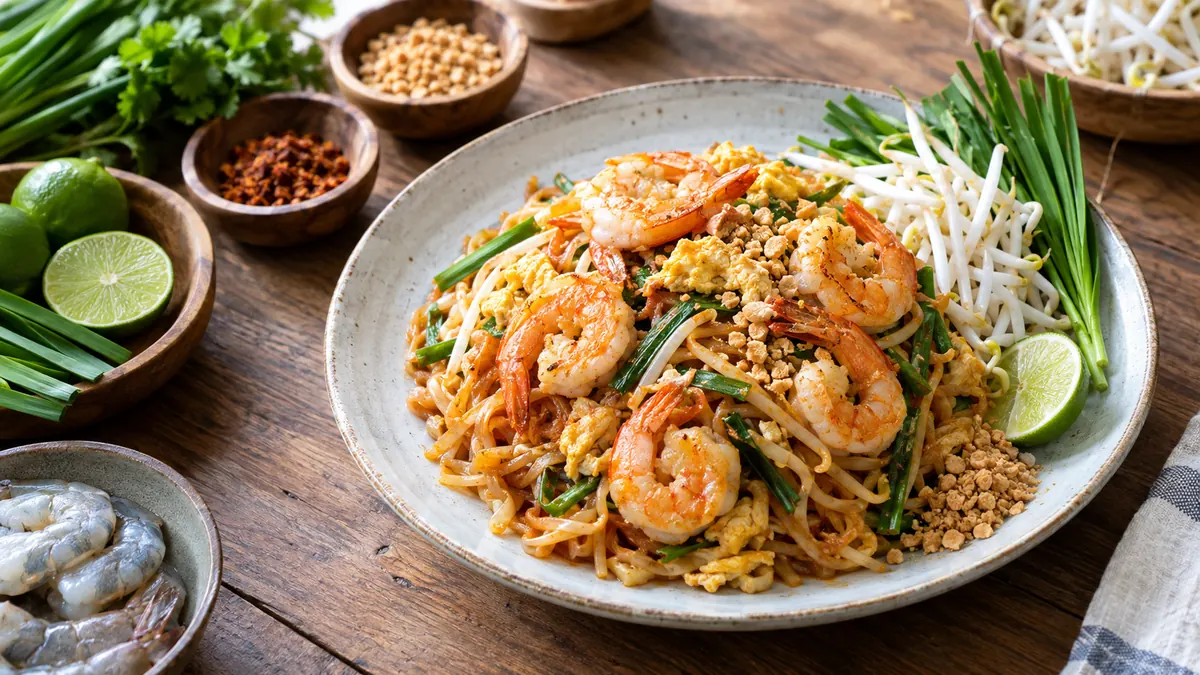
How Did Pad Thai Become Thailand's Favorite? The Story and a Shrimp Recipe
Pad Thai is stir-fried rice noodles with tamarind, egg, peanuts and fresh lime. It is one of the best-known Thai dishes in the world, and many people assume it is ancient. The truth is more recent, and more interesting. This recipe uses shrimp or halal chicken and no pork or alcohol.
The story of pad Thai
Food writers explain that the dish is not native to Thailand in the way many think. Its full name, kway teow pad Thai, hints at Chinese origins. Rice noodles, and the technique of stir-frying them in a wok, came with Chinese settlers who had long lived in Thailand, so some early version of stir-fried noodles was probably already there.
The modern pad Thai is linked to the late 1930s. At that time, Prime Minister Plaek Phibunsongkhram led a government that wanted to build a modern national identity. The country’s name was changed from Siam to Thailand, and the government promoted a national noodle dish. Historians say there is not much documentation of exactly how the dish was created, and some trace it to a cooking competition, but the story is repeated in many sources. From street stalls the dish spread to restaurants, and then around the world.
Ingredients (serves 3 to 4)
- 250 g flat rice noodles (about 5 mm wide)
- 300 g shrimp, peeled, or sliced halal chicken
- 3 tbsp vegetable oil
- 3 cloves garlic, minced
- 1 shallot, minced
- 2 eggs
- 2 cups bean sprouts
- 4 spring onions or garlic chives, cut into pieces
- 1/3 cup roasted peanuts, crushed
- Lime wedges, chili flakes
For the sauce: - 3 tbsp tamarind paste - 3 tbsp palm sugar or brown sugar - 3 tbsp fish sauce (check it is alcohol-free) or soy sauce - 1 tbsp water - 1 tsp chili flakes (optional)
Method
- Soak the noodles in warm (not boiling) water for 20 to 30 minutes, until flexible but still firm. Drain.
- Mix the sauce ingredients in a small pot and warm gently until the sugar dissolves. Taste: it should be sour, sweet and salty at once.
- Heat 1 tbsp of oil in a wok over high heat. Cook the shrimp for 1 to 2 minutes, then remove.
- Add the remaining oil, garlic and shallot. Stir for 20 seconds.
- Add the noodles and sauce. Toss for 2 to 3 minutes, adding splashes of water if the noodles are still hard.
- Push the noodles to the side. Crack the eggs into the empty space, scramble for 30 seconds, then mix into the noodles.
- Add the shrimp, bean sprouts and spring onions. Toss for 30 seconds.
- Serve with crushed peanuts, lime and chili flakes.
Tips
Do not over-soak the noodles. They finish cooking in the wok, and soft noodles will break up. Cook in small batches, since a crowded wok steams instead of fries. Use high heat and keep things moving. Taste the sauce before adding it and adjust the balance of sour, sweet and salty to your taste.
Making it halal
Traditional pad Thai can include dried shrimp, fish sauce and sometimes pork fat or pork in street versions. Use shrimp, chicken or tofu, and read the labels of the sauces. Some fish sauces and oyster sauces are fine, but check for added alcohol or non-halal ingredients. Tamarind paste and palm sugar are plant-based.
Variations
Make it with tofu and extra vegetables for a vegetarian dish, using soy sauce in place of fish sauce. Add shredded carrot or cabbage for crunch. Use halal chicken thigh strips for a heartier plate. A squeeze of lime at the end brightens everything.
Storage
Pad Thai is best eaten right away, since the noodles stiffen in the fridge. If you have leftovers, store for one day and reheat in a pan with a splash of water.
Frequently asked questions
Why are my noodles clumped? They were over-soaked or the wok was not hot enough. Toss constantly and add a splash of water.
Is pad Thai spicy? Usually mild. Chili flakes are served on the side so each person adjusts the heat.
Can I use another noodle? Thin rice noodles work, but the texture will differ. Avoid thick ones.
What is tamarind paste? A sour fruit paste from the tamarind tree. It is the key flavor of the sauce, and it is sold in jars or blocks.
Sources
The history comes from the BBC (https://www.bbc.com/travel/article/20150415-the-quest-for-the-perfect-pad-thai), Atlas Obscura (https://www.atlasobscura.com/articles/who-invented-pad-thai) and Smithsonian Magazine (https://www.smithsonianmag.com/travel/the-surprising-history-of-pad-thai-180984625/). Details of the dish’s creation are not fully documented, so the story is presented with that caution.
Understanding the flavor balance
Pad Thai is built on three tastes. Tamarind brings sourness, palm sugar brings sweetness, and fish sauce or soy sauce brings salt. A good cook tastes the sauce and balances them until none of them stands out. If your pad Thai tastes flat, it needs more salt or sour. If it tastes harsh, add a little more sugar. The peanuts add crunch, the bean sprouts add freshness, and the lime brings everything back to life at the end.
Setting up the wok
Stir-frying is fast, so prepare everything before you start. Put the soaked noodles, the sauce, the eggs, the shrimp, the sprouts and the garnishes in separate bowls next to the stove. Heat the wok until it is very hot, and cook in small batches. For two servings at a time, you will get a better result than one big batch. If you do not have a wok, use the largest, heaviest frying pan you own.
Street-style touches
Street cooks often add a spoon of sweet pickled radish and a few dried shrimp to the pan. For a halal home version, skip the dried shrimp if you are unsure of the source, and use finely chopped pickled radish if you can find it. Serve with a wedge of lime, crushed peanuts and a little sugar, chili flakes and fish sauce at the table so each person can season their own plate.