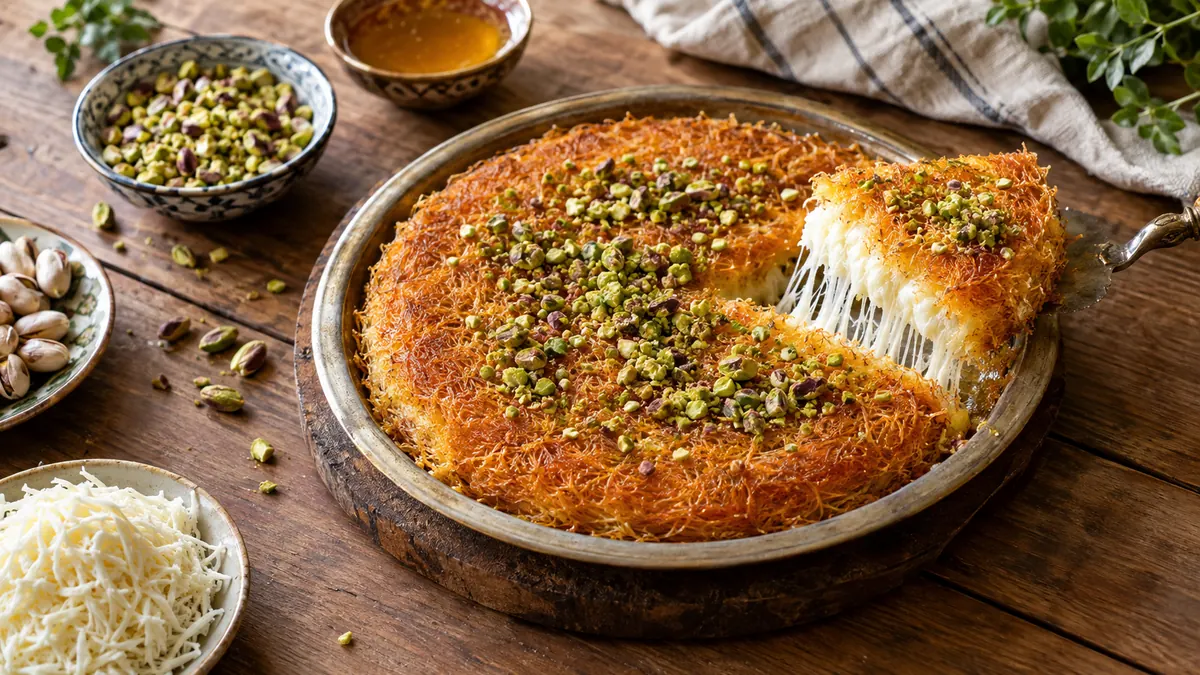
Crisp, Cheesy, Syrup Soaked: The Story of Kunafa and a Halal Recipe
Kunafa, also spelled knafeh or kanafeh, is a dessert with two very different textures in one bite. The top and bottom are crisp and golden. The middle is soft, warm and stretchy with melted cheese. A fragrant sugar syrup ties it all together. It is a favorite during Ramadan, at weddings and at family gatherings across the Arab world and Turkey, and it keeps showing up in trending food videos because of the cheese pull. This article looks at where it comes from and how to make it at home.
A dessert of the Levant
Kunafa is closely tied to the Levant. The Palestinian city of Nablus is especially famous for its cheese kunafa, known as kunafa nabulsiya, made with a mild white cheese. Writing in The Economist about knafeh, the author describes it as a Levantine pudding with a devoted following, and the Goethe Institut also covers its place in regional food culture. Versions exist in Lebanon, Syria, Jordan, Egypt, Turkey, Greece and beyond, and each place has its own way of making it.
What is the real origin?
There are several stories. One popular tale says kunafa was made for a caliph in the early Islamic period, to help him during long fasts. Historians are cautious about such stories, and the honest answer is that the exact origin is not settled. What we can say is that sweet shredded pastries appear in medieval Arabic cookbooks, and the dessert spread through the Ottoman world. Many countries claim it, and all of them cook it with pride.
The two main styles
The pastry comes in two forms. Khishneh, sometimes called kataifi, is fine shredded dough that bakes into a crunchy, nest like crust. Naameh is a soft semolina based dough that gives a smoother, more tender layer. Many cooks use khishneh on top and bottom, with a thin layer of semolina or cheese in between. Which you pick depends on the texture you want. Crunch lovers go for khishneh, and those who like softness choose naameh.
The cheese
The cheese is what makes or breaks the dish. Traditional kunafa uses a fresh, mild white cheese that melts without turning oily. Nabulsi cheese is the classic choice, soaked to remove excess salt. At home, many people use a mix of mozzarella and a soft fresh cheese such as ricotta or akkawi, which gives the stretch and the mild flavor. Always check labels so the cheese is made with halal-suitable rennet if that matters in your home.
The syrup
The syrup, called qatr or ater, is simple: sugar, water and a squeeze of lemon, simmered for ten minutes. A teaspoon of rose water or orange blossom water adds a floral note. The usual rule is to pour cool syrup over hot kunafa, or hot syrup over cool kunafa, so the crust stays crisp.
Halal kunafa recipe
Serves 8. Time: 1 hour.
For the syrup:
- 1 cup sugar
- 1/2 cup water
- 1 teaspoon lemon juice
- 1 teaspoon rose water or orange blossom water
For the kunafa:
- 400 g kataifi or shredded kunafa dough, thawed
- 150 g butter or ghee, melted
- 300 g mozzarella, shredded
- 150 g ricotta or fresh white cheese
- Crushed pistachios for topping
Method:
- Make the syrup. Simmer sugar, water and lemon juice for 8 to 10 minutes. Add the flower water and let it cool.
- Heat the oven to 200 C (400 F). Pull the dough apart with your fingers, then mix it with the melted butter until every strand is coated.
- Press half of the dough firmly into a buttered 24 cm round pan.
- Mix the cheeses and spread them over the dough, leaving a small border.
- Cover with the remaining dough and press down firmly. This keeps it together when you flip or slice it.
- Bake for 30 to 35 minutes until deep golden.
- Pour the syrup over the hot kunafa. Top with pistachios. Rest for 5 minutes, then serve warm.
Tips
Press hard. Loose dough makes a crumbly dessert, so compress it well.
Do not skimp on butter. It is what turns the strands crisp and golden.
Serve warm. The cheese sets as it cools, and the stretch is the whole point.
Do not over sweeten. A light syrup lets the cheese flavor shine.
Why people love it during Ramadan
After a day of fasting, kunafa is rich and satisfying, and it is easy to share. Many families buy it fresh from a bakery after iftar, and many homes now bake it in a skillet for a smaller group. It also keeps in the fridge for a couple of days and reheats well in the oven.
The takeaway
Kunafa is a dessert with an old story, a clear regional home in the Levant, and many claimants. Make it for guests, share it warm, and enjoy the crunch and the cheese.
Frequently asked questions
Can I make kunafa without the special dough? Yes. Shredded phyllo from the freezer section works, and so do crushed vermicelli noodles fried in butter, though the texture is slightly different.
Why did my kunafa turn soggy? Usually the syrup was too sweet or too hot, or the cheese released too much water. Drain the cheese well and let one part (syrup or kunafa) be cool when you combine them.
Can I prepare it ahead? Yes. Assemble it in the pan, cover and chill for up to a day, then bake just before serving. This is handy for Ramadan, when the evening is busy.
What is the best way to reheat it? Warm slices in a 160 C (320 F) oven for 8 to 10 minutes. The microwave softens the crust, so avoid it if you can.
What can I serve with it? Strong black tea, Arabic coffee or a small glass of cold milk. Many families also serve it with a spoon of clotted cream, called ashta, which is a traditional topping.