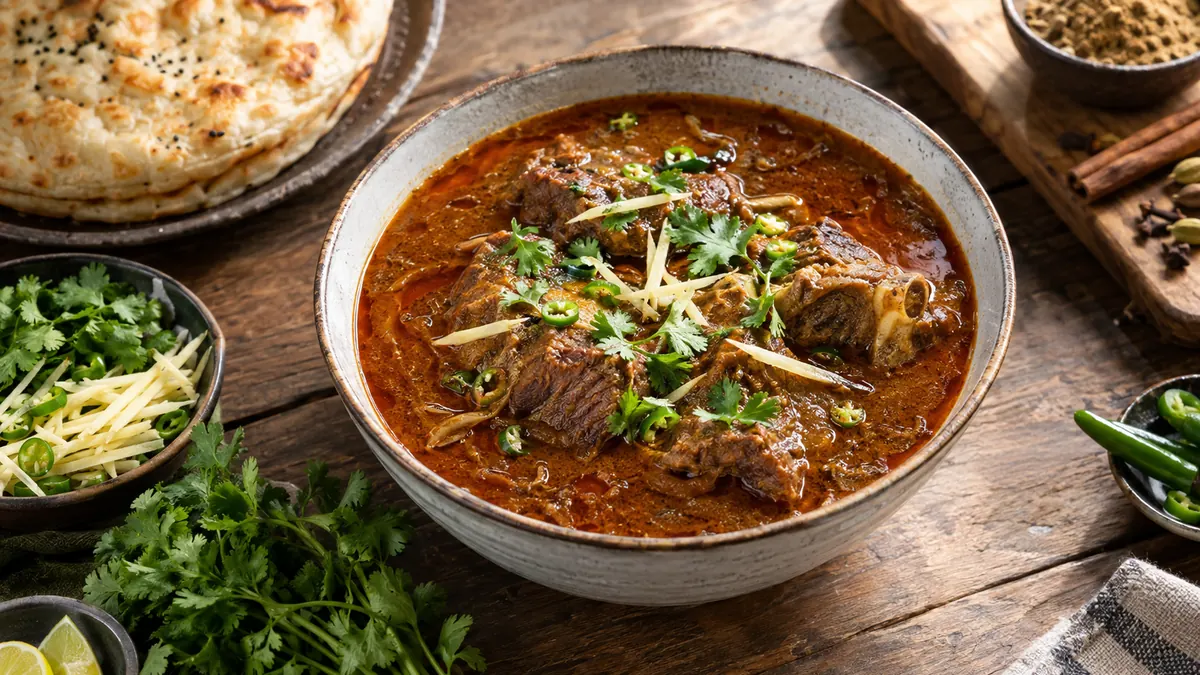
Why Is Nihari Eaten at Dawn? The Slow Cooked Morning Stew and a Halal Recipe
Nihari is a stew you cook with patience. Beef, mutton or goat shank is simmered for hours in a spiced gravy until the meat falls from the bone and the sauce turns glossy and thick. It is eaten with hot naan and fresh ginger, and it is especially loved in the cold months and during Ramadan and Eid. It is trending because slow cooked comfort food is popular, and because many home cooks are curious about it. Here is the story and a halal recipe.
A morning dish
The word nihari comes from the Arabic word nahar, which means morning or day, according to reporting in the Times of India and Mint. Traditionally, the stew was cooked overnight and eaten early in the morning, after the dawn prayer, as a strong meal for the day. In Old Delhi, shops that sell nihari still open in the early hours. In Pakistan, especially Karachi and Lahore, it is a popular breakfast or weekend meal.
Two stories about its origin
Wikipedia and an excerpt from the book Masalamandi, published by Scroll, describe two common theories about nihari’s beginnings. One says it started in the kitchens of the Mughal court in Delhi and later spread outward. The other says it was a humble food for workers and laborers, who ate a hearty meal that kept them going through the day. Both stories are told in Old Delhi and Lucknow. There is no firm proof for either, so it is best to say that the dish is tied to Mughal era Delhi and has been shaped by many kitchens since, including in Pakistan after 1947.
What makes nihari different
Nihari has a particular spice blend, called nihari masala. It usually contains fennel, dried ginger, cloves, cardamom, nutmeg, mace, black pepper and long pepper, and its sauce is thickened with flour or atta, which is toasted in ghee and added slowly. Bone marrow is often included and gives the gravy its richness. The dish is served topped with julienned ginger, green chilies, fresh coriander and a squeeze of lemon.
Halal nihari recipe
Serves 6. Time: about 3 hours.
Ingredients:
- 1 kg halal beef shank or lamb shoulder, with bones
- 1/2 cup ghee or oil
- 2 onions, sliced and fried until deep brown
- 2 tablespoons ginger garlic paste
- 1 teaspoon each red chili powder, coriander powder and turmeric
- 2 tablespoons nihari masala (or 1 tablespoon garam masala, 1 teaspoon fennel and 1 teaspoon ground ginger)
- 1/2 cup plain yogurt
- 3 tablespoons whole wheat flour (atta)
- Salt
- About 6 cups water
To serve: julienned ginger, green chilies, chopped coriander, lemon wedges and naan.
Method:
- Heat half the ghee in a heavy pot. Brown the meat in batches. Set aside.
- In the same pot, add the ginger garlic paste, spices and yogurt. Cook for 5 minutes.
- Return the meat. Add the fried onions, salt and water. Bring to a boil, cover and simmer on low for 2 1/2 to 3 hours, until the meat is very tender.
- Toast the flour in the remaining ghee until light golden. Whisk it with a little cold water, then pour it into the stew slowly, stirring constantly.
- Cook for another 15 minutes until the gravy is thick and glossy. Skim off excess oil if you like.
- Top with ginger, chilies and coriander. Serve with naan and lemon.
Tips
Cook it low and slow. Time is the main ingredient.
Use bones. Marrow and collagen make the gravy rich.
Add the flour slowly. This avoids lumps.
Make it a day ahead. Like many stews, it tastes better the next day.
Garnish well. The ginger and lemon cut through the richness.
Frequently asked questions
Can I use a pressure cooker? Yes. Cook for about 45 minutes under pressure, then thicken the gravy on the stove.
Is nihari very spicy? It is warm and aromatic, with heat from chili that you can adjust.
What do I serve with it? Naan, sheermal, or kulcha are traditional, plus fresh ginger and lemon.
Can I use chicken? Yes, though it is not traditional and will cook much faster.
How do I store it? Keep refrigerated for four days or freeze for up to three months.
The takeaway
Nihari is patient food with a long, debated history. Make a big pot, share it on a cold morning and take your time with it.
Serving and menu ideas
Nihari is a full meal on its own, but it is also lovely with a few side dishes. Serve it with plain basmati rice if you do not have naan, and add a simple salad of sliced onion, cucumber and lemon. For Eid or a weekend brunch, set out small bowls of ginger, chilies, coriander and lemon so each person can garnish their own bowl. Leftover nihari is excellent the next day, and the gravy can be used as a filling for a paratha wrap. If you plan to cook it overnight, use a slow cooker on low for 8 to 10 hours, then add the thickened flour paste in the morning.